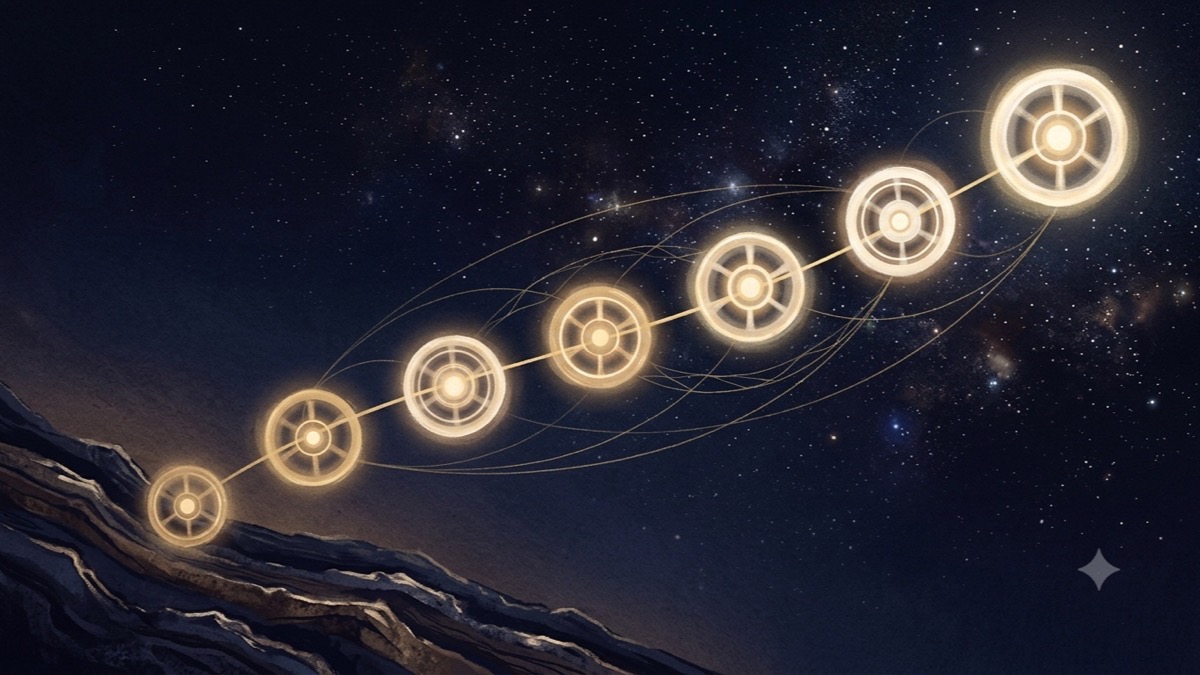
This chakra system overview treats the seven energy centers as one connected family rather than seven separate labels. The chakra system is a framework for reading inner experience through body-located themes — safety, desire, confidence, connection, expression, insight, and integration — and its real value shows up only when you read each center against the other six. Below you get the quick map of all 7 chakras, then the part most guides skip: how shade, intensity, and combination change what a single center is actually telling you. Use it as the hub, then follow the links to go deep on any one center.
What Are the Chakras?
The chakra system is a seven-center framework for reading inner experience through body-located themes such as safety, desire, confidence, connection, expression, insight, and spiritual integration. In the most familiar modern map, it names seven main chakras: root, sacral, solar plexus, heart, throat, third eye, and crown. Each center works like a reference point, not a separate object you can measure or a hidden organ. Classical Indian and Tantric traditions contain several chakra maps, and modern aura writing often uses the seven-center version because it gives readers a simple shared vocabulary. The names usually move from the base of the body upward, pairing a location image with a life domain. That lets the set function as a family: one center may be loud in a given situation, but its meaning becomes clearer when you see how it relates to the other six.
Why It Matters for Self-Awareness
The chakra system matters for self-awareness because it gives you a shared vocabulary for comparing life domains without turning them into diagnoses. Most readers who search for "what are chakras" are not asking for a costume, a medical chart, or a promise that hidden powers will appear. They usually want a clear map. The problem is that many articles skip the map and jump straight into fixed claims: root equals fear, throat equals truth, crown equals enlightenment. That can sound simple, but it leaves out the part that makes the model useful. A single center only makes sense inside the family. Confidence can look different when safety is shaky. Compassion can become avoidance when expression goes quiet. Insight can drift away from daily life when grounding is ignored.
The chakra system matters because it gives you a vocabulary for comparing life domains without turning them into diagnoses. If you notice that you avoid conflict, you could read that only as a throat issue, meaning "I do not speak." But the broader set asks better questions: Do you feel unsafe at the root level? Are you trying to protect connection at the heart level? Is your solar plexus sense of agency underfed? This is why a hub view comes before single-center pages. It helps you avoid taking one label as the whole story. It also makes the phrase "7 chakras explained" less shallow. Instead of memorizing seven meanings, you can compare domains: safety before desire, desire before will, will before care, care before voice, voice before insight, insight before integration. The order is not a ladder of personal worth. It is a reading sequence that keeps ordinary life in the picture.
It also keeps the framework honest. Chakras are often described with body locations, but those locations are reference points inside an interpretive tradition, not proof that a center is an organ, gland, or measurable object. That boundary does not make the model useless. It makes the use case cleaner. You can treat the centers as prompts for self-observation: Where do I feel steady? Where do I reach for pleasure or shut it down? Where do I act from choice? Where do I confuse care with self-erasure? Used that way, the seven centers can help you name patterns before they harden into identity. The goal is not to become "a throat person" or "a crown person." The goal is to see which domain is asking for attention in a specific moment.
The Chakra System at a Glance
| Energy Center | Color Association | Life Domain | Sibling Aura Color | Core Theme | Common Misread |
|---|---|---|---|---|---|
| Root chakra | Red | Safety, grounding, survival needs | Red aura | Embodied stability and boundaries | "Root work means staying practical and never changing." |
| Sacral chakra | Orange | Pleasure, desire, creativity, adaptation | Orange aura | Feeling, play, and creative movement | "Sacral energy is just indulgence or immaturity." |
| Solar plexus chakra | Yellow | Will, confidence, agency, choice | Yellow aura | Personal power and clear direction | "Solar plexus focus means ego or domination." |
| Heart chakra | Green | Love, grief, connection, compassion | Green aura | Relational balance and care | "Heart energy means endless giving." |
| Throat chakra | Blue | Voice, truth, listening, expression | Blue aura | Honest communication | "Throat balance means saying everything all the time." |
| Third eye chakra | Purple or indigo | Intuition, perception, pattern-reading | Purple aura | Inner seeing and discernment | "Third eye focus means every hunch is correct." |
| Crown chakra | White or violet | Meaning, integration, spiritual perspective | White aura | Spacious awareness and connection to something larger | "Crown energy makes someone superior or finished." |
The 7 Chakras: Quick Guide
In this chakra system, read each center as a life domain first and a color association second; the sibling aura color gives a related language for how that domain may show up around a person.
Root Chakra — Safety and Grounding
The root chakra is the ground floor of the seven-center map: safety, stability, basic trust, money pressure, home, and the body's demand to feel here. Its sibling is the red aura, which often reads as drive, embodiment, and readiness to act. A balanced root does not mean you never move or never feel fear; it means you can make choices without being run by panic. Common misread: treating root energy as crude, angry, or "less spiritual." In practice, many higher-level reflections fall apart when basic steadiness is missing. Go deeper in the root chakra meaning explainer, or read the sibling red aura explainer.
Sacral Chakra — Desire and Creativity
The sacral chakra points to desire, creativity, pleasure, emotional flow, and the ability to respond to change. Its sibling is the orange aura, which often reads as playful, sensual, experimental, or creatively alive. A strong sacral pattern can show up in art, attraction, movement, humor, or a willingness to try before every detail is settled. Common misread: calling sacral energy reckless by default. The better question is whether the movement has presence and consent, or whether it is being used to avoid commitment, grief, or discomfort. Go deeper in the sacral chakra meaning explainer, or read the sibling orange aura explainer.
Solar Plexus Chakra — Will and Agency
The solar plexus chakra is about agency: choosing, acting, leading, refusing, and trusting your own direction. Its sibling is the yellow aura, often read as confidence, clarity, momentum, and a mind that is switched on. This center is useful when you are asking, "What do I actually want to do, and can I stand behind it?" Common misread: flattening solar plexus energy into ego. Confidence can become pushy, but lack of agency can also hide behind politeness. The clean version feels decisive without needing to control everyone else. Go deeper in the solar plexus chakra affirmations guide, or read the sibling yellow aura explainer.
Heart Chakra — Love and Connection
The heart chakra covers love, grief, empathy, forgiveness, belonging, and the pain of caring in a world that does not always respond gently. Its sibling is the green aura, often read as compassionate, healing-oriented, relational, and steady. Heart work is not about being endlessly nice. It asks whether care can include both openness and boundaries. Common misread: assuming heart energy means self-sacrifice. A green-heart pattern can be generous, but it can also overfunction when someone uses helping to avoid honesty, anger, or their own needs. Go deeper in the heart chakra meaning explainer, or read the sibling green aura explainer.
Throat Chakra — Voice and Expression
The throat chakra points to speech, listening, timing, honesty, and the gap between what you know and what you say. Its sibling is the blue aura, often read as calm presence, truth, teaching, writing, and careful communication. A balanced throat is not just "speaking your truth" at full volume; it also includes hearing another person without losing your own signal. Common misread: thinking throat energy means verbal bluntness. Sometimes the clearer move is fewer words, a cleaner boundary, or a pause before language turns reactive. Go deeper in the throat chakra meaning explainer, or read the sibling blue aura explainer.
Third Eye Chakra — Perception and Pattern
The third eye chakra is associated with perception, intuition, imagination, dreams, symbols, and the ability to see patterns across events. Its sibling is the purple aura, often read as inward, visionary, meaning-oriented, or highly attuned to subtle cues. This center can help when the facts are present but the pattern has not yet landed. Common misread: treating every hunch as authority. A third-eye reading needs discernment. Insight becomes more useful when it can be checked against behavior, timing, and what other people actually say and do. Go deeper in the ajna (third eye) chakra explainer, or read the sibling purple aura explainer.
Crown Chakra — Integration and Meaning
The crown chakra points to integration, spiritual perspective, humility, meaning, and the sense that life is wider than the personal ego. Its sibling is the white aura, often read as spacious, clean, quiet, or reset-like. Crown language can be helpful during endings, retreats, prayer, meditation, or periods when old roles loosen. Common misread: treating crown energy as a rank. A person is not better because this center is active, and blankness is not the same as clarity. The useful question is whether perspective helps daily life become more honest and kind. Go deeper in the crown chakra meaning explainer, or read the sibling white aura explainer.

How Shade and Combination Shift Readings
The chakra system gets more useful when you stop reading the centers as seven separate drawers. Real experience is mixed. A person can feel grounded in one area and scattered in another. A conversation can activate heart and throat at the same time. A creative season can light up sacral movement while also asking for solar plexus discipline. This is where shade, intensity, and combination matter. The color attached to each center gives you a first clue, but the way that color is described - clear, muddy, bright, soft, heavy, hot, pale - often says more about the current state than the center name does.
Reading Clarity vs Strain in the Same Center
Take red and the root. Clear red can point to embodied action: paying the bill, making the move, setting the boundary, cooking the meal, getting sleep. Muddy red can point to strain around the same domain: urgency, defensiveness, pressure, or the feeling that everything has to be solved now. The center is still root, but the shade changes the reading. The same logic applies to yellow. Clear yellow can be self-trust and direction; harsh yellow can feel like performance pressure, constant proving, or a refusal to admit uncertainty.
Common Two-Center Combinations
Combinations are even more revealing. Heart plus throat can describe a person trying to speak truth without losing tenderness. If the mix is clear, it may sound like a hard conversation handled with care. If it is strained, it may look like editing every sentence until the truth disappears. A deeper blue gets you more depth of expression, but loses the easy warmth that helps other people ask questions. That does not make deep blue wrong. It simply shows the trade-off: more precision, less approachability.
Sacral plus solar plexus is another common pair. Orange wants movement, play, and discovery. Yellow wants direction and choice. Together, they can describe an artist launching work, a person dating with more honesty, or a founder testing an idea without waiting for perfect confidence. Under stress, the same pair can turn into chasing stimulation while calling it purpose. Crown plus root creates a different tension: wide perspective needs ordinary anchoring. Without root, crown language can float above the unpaid bill, the hard conversation, or the need for rest. Without crown, root can shrink life down to control and survival. Good readings keep both ends in view.
This is also where lineage differences become less confusing. Some maps use five centers, some emphasize seven, and some name more. Some color systems split indigo and violet, while others fold them into purple or white language. Instead of forcing every chart to match, ask what the map is trying to sort: body-located themes, meditative practice, ritual symbolism, aura colors, or daily self-reflection. The centers are not identical across every tradition, but the comparison can still be useful when you keep the frame clear.

Common Misreads + Framework Limits
A chakra system reading becomes weaker when it tries to sound more certain than it can be. The first misread is treating the centers as a diagnostic grid. If someone says your throat is "blocked," that should not become a verdict about your health, your future, or your worth. At most, it is a prompt: Where am I not saying what needs to be said? Where am I talking too much to avoid listening? Where does my voice feel timed, tense, or withheld? The answer still has to be checked against real relationships and real choices.
The second misread is arguing over one "true" chart without asking which lineage, practice setting, or teaching purpose is being used. Classical and modern systems do not all count or name the centers the same way. Seven is the version most common in modern English-language aura and yoga-adjacent writing, but it is not the only possible map. That does not mean anything goes. It means the honest move is to name the frame you are using, then avoid pretending it settles every tradition.
The third misread is turning the framework into identity branding. "I am heart-centered" can be a useful shorthand for a day. It becomes limiting when it excuses people-pleasing, avoids conflict, or makes other centers seem less worthy. "I am third-eye dominant" can name a reflective style. It becomes risky when every intuition gets treated as fact. "I am crown energy" can sound spacious. It becomes a problem if ordinary duties and relational repair are treated as beneath the person.
The fourth limit is that chakra language cannot replace clinical care, direct communication, or practical evidence. If you are sick, unsafe, or in a recurring harmful pattern, color and center language should not be used as the final authority. It can help you describe what the situation feels like. It cannot tell another person what they meant, prove a diagnosis, or erase the need for support. It also cannot make a hard choice painless. A center may point to the domain involved, but it will not decide whether you should leave, apologize, rest, ask for help, or change a habit. The most adult use is modest: let the map organize reflection, then bring the insight back to behavior. What did you say? What did you avoid? What boundary would change the pattern? What repair is needed now?

Reflection Prompts
- Think of a recent moment when safety felt shaky; what did your body want, and which center seemed loud?
- Recall a conversation where care muted truth; what would heart and throat both need from you?
- Think of a week when insight outpaced grounding; what practice brought the pattern back into daily life?
Related Reading
- root chakra explainer
- sacral chakra explainer
- solar plexus chakra explainer
- heart chakra explainer
- throat chakra explainer
- third eye chakra explainer
- crown chakra explainer
- red aura explainer
- orange aura explainer
- yellow aura explainer
- green aura explainer
- blue aura explainer
- purple aura explainer
- white aura explainer
- aura colors guide — how the seven aura colors map onto the chakra centers
- chakra test — self-assess which center is asking for attention
- crystals for each chakra
Questions People Ask About the 7 Chakras
What are the chakras?
The chakra system is a seven-center framework for reading inner experience through body-located themes such as safety, desire, confidence, connection, expression, insight, and spiritual integration. In the most familiar modern map, it names seven main chakras: root, sacral, solar plexus, heart, throat, third eye, and crown. Each center works like a reference point, not a separate object you can measure or a hidden organ.
Are there always exactly seven chakras?
Seven is the version most common in modern English-language aura and yoga-adjacent writing, but it is not the only possible map. Some maps use five centers, some emphasize seven, and some name more, and classical Indian and Tantric traditions contain several chakra maps. The honest move is to name the frame you are using rather than pretending one chart settles every tradition.
What order do the 7 chakras go in?
The names usually move from the base of the body upward, pairing a location image with a life domain: root, sacral, solar plexus, heart, throat, third eye, and crown. The article frames this as a reading sequence — safety before desire, desire before will, will before care, care before voice, voice before insight, insight before integration. The order is not a ladder of personal worth.
Can chakras diagnose health problems?
No. Chakra language cannot replace clinical care, direct communication, or practical evidence, and body locations are reference points inside an interpretive tradition, not proof that a center is an organ, gland, or measurable object. If someone says a center is "blocked," treat it as a prompt for self-observation rather than a verdict about your health, future, or worth.
Take Action
If you want a quick entry into the chakra system, start by reading which center is loudest for you right now, then follow it into its own page. The chakra test walks through how to self-assess each center, and from there you can go deep on whichever one your reading flags — the root chakra for safety, the sacral chakra for creativity, or the solar plexus for will and confidence.